Modification of biochar with carbon nanotubes for potential application as an advanced CO2 adsorbent
DOI:
https://doi.org/10.29105/qh15.01-510Keywords:
biochar, carbon nanotubes, CO₂ adsorption capacity, corn husk, pyrolysisAbstract
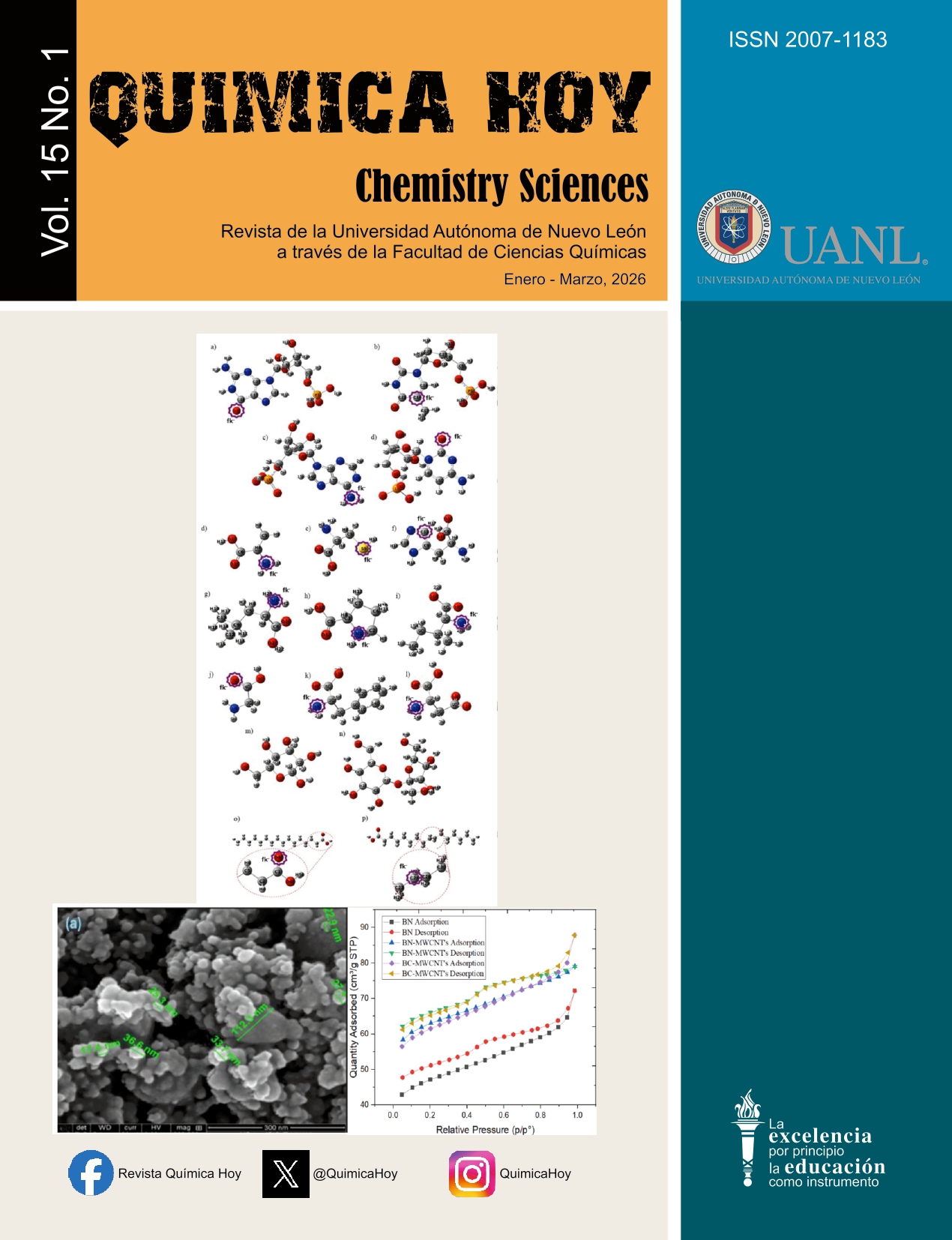
In the present work, biochar composites were produced with multiwall carbon nanotubes, MWCNT’s. The composites were characterized by Fourier transform infrared spectroscopy (FT-IR), X-ray diffraction (XRD) and surface area analysis (BET) techniques to evaluate the effect of the modifications on the adsorption capacity of CO2. The objective of this work is to obtain a biochar-based composite with a CO2 adsorption capacity 10% higher than that of unmodified biochar (72.6 mg/g). This was achieved by obtaining the biochar from mango peel, orange peel and corn husk by slow pyrolysis and modifying said biochar with MWNCTs by physisorption and ultrasonic cavitation. The purpose of this project consisted of the modification of biochar increases the capacity to adsorb CO2 by at least 10%, which was corroborated by being subjected to a CO2 chamber and verifying its adsorption with a CO2 atmosphere meter. In conclusion, it can be mentioned that the adsorption capacity of corn husk biochar modified with multi-wall carbon nanotubes (BH-MWCNT's) increased by 123% for carbon dioxide.
Downloads
References
- [1]. Cheng, H. Future Earth and Sustainable Developments. The Innovation. 2020, 1(3), 100055. DOI: https://doi.org/10.1016/j.xinn.2020.100055
- [2]. Klaaßen, L.; Stoll, C. Harmonizing corporate carbon footprints. Nat. Commun. 2021, 12(1), 1-13. DOI: https://doi.org/10.1038/s41467-021-26349-x
- [3]. Haszeldine, R.; Flude, S.; Scott, V. Negative emissions technologies and carbon capture and storage to achieve the Paris Agreement commitments. Phil. Trans. R. Soc. A. 2018, 376(2119), 20160447. https://doi.org/10.1098/rsta.2016.0447. DOI: https://doi.org/10.1098/rsta.2016.0447
- [4]. Yang, W.; Min, Z.; Yang, M.; Yan, J. Exploration of the Implementation of Carbon Neutralization in the Field of Natural Resources under the Background of Sustainable Development—An Overview. Int. J. Environ. Res. 2022, 19(21), 1-28. DOI: https://doi.org/10.3390/ijerph192114109
- [5]. Kharissova, A.B.; Kharissova, O.V.; Kharisov, B.I.; Peña Méndez, Y. Carbon negative footprint materials: A review. Nano-Struct. Nano-Objects. 2024, 37, 101100. doi: 10.1016/j.nanoso.2024.101100. DOI: https://doi.org/10.1016/j.nanoso.2024.101100
- [6]. Chen, L.; Msigwa, G.; Yang, M. Strategies to achieve a carbon neutral society: a review. Environ. Chem. Lett. 2022, 20, 2277-2310. DOI: https://doi.org/10.1007/s10311-022-01435-8
- [7]. Gao, H.; Li, Y.; Xie, Y.; Liang, D.; Li, J.; Wang, Y.; Xiao, Z.; Wang, H.; Gan, W.; Pattelli, L.; Xu, H. Optical wood with switchable solar transmittance for all-round thermal management. Composites Part B: Engineering. 2024, 275, 111287. DOI: https://doi.org/10.1016/j.compositesb.2024.111287
- [8]. Rajendran, A.; Sakthivel, A.; Dong, Z.; Li, W. What makes biochar an interesting CO2 adsorbent? Frontiers of Chemical Science and Engineering, 2024, 19, article number 12. DOI: https://doi.org/10.1007/s11705-024-2516-z
- [9]. Zhang, C.; Ji, Y.; Li, C.; Zhang, Y.; Hu, Y.; Jiang, L.; Wu, C. The Application of Biochar for CO2 Capture: Influence of Biochar Preparation and CO2 Capture Reactor. Ind. Eng. Chem. Res. 2023, 62(42), 17168–17181. DOI: https://doi.org/10.1021/acs.iecr.3c00445
- [10]. Zhang, Y.; He, M.; Wang, L.; Yan, J.; Ma, B.; Zhu, X. et al. Biochar as construction materials for achieving carbon neutrality. Biochar. 2022, 4, 59. DOI: https://doi.org/10.1007/s42773-022-00182-x
- [11]. Ghazali, M.S.M.; Zaini, M.S.M.; Arshad, M.; Syed-Hassan, S.S.A. Co-production of biochar and carbon nanotube from sewage sludge in a two-stage process coupling pyrolysis and catalytic chemical vapor deposition. Waste Disposal & Sustainable Energy, 2024, 6, 323–334. DOI: https://doi.org/10.1007/s42768-024-00194-2
- [12]. Xue, Q; Xie, S; Zhang, T. Biochar production and modification for environmental improvement. In: Biochar in Agriculture: Achieving Sustainable Development Goals. 2022, 181-191. doi: 10.1016/B978-0-323-85343-9.00025-2. DOI: https://doi.org/10.1016/B978-0-323-85343-9.00025-2
- [13]. Yaashikaa, R.; Senthil Kumar, P.; Varjani, S.; Saravanan, A. A critical review on the biochar production techniques, characterization, stability and applications for circular bioeconomy. Biotechnol Rep (Amst). 2020, 28, 1-15. DOI: https://doi.org/10.1016/j.btre.2020.e00570
- [14]. Jagnade, P.; Panwar, N.L. Experimental investigation on the performance of activated bamboo biochar for CO2 and PM2.5 adsorption. Emergent Mater. 2024, 7, 1227–1238. doi: 10.1007/s42247-024-00624-1. DOI: https://doi.org/10.1007/s42247-024-00624-1
- [15]. Cao, D.; Niu, R.; Mo, G.; Deng, H.; Liu, R.; Fan, J. Adsorption properties and competitive adsorption mechanism exhibited by carbon-nanotube-modified biochar for removal of crude oil and Ni(II) pollutants from water. Ecotoxicology and Environmental Safety, 2025, 290, 117557. DOI: https://doi.org/10.1016/j.ecoenv.2024.117557
- [16]. Kwon, C.W.; Tae, S.; Mandal, S. Comparative Analysis of CO2 Adsorption Performance of Bamboo and Orange Peel Biochars. Molecules 2025, 30(7), 1607. DOI: https://doi.org/10.3390/molecules30071607
- [17]. Hassan, R.; Baghban, A. Predicting CO2 adsorption in KOH-activated biochar using advanced machine learning techniques. Scientific Reports, 2025, 15, Article number: 24410. DOI: https://doi.org/10.1038/s41598-025-09248-9
- [18]. Janu, R.; Mrlik, V.; Ribitsch, D.; Hofman, J; Sedláček, P.; Bielská, L.; Soja, G. Biochar surface functional groups as affected by biomass feedstock, biochar composition and pyrolysis temperature. Carbon Resources Conversion, 2021, 4, 36-46. DOI: https://doi.org/10.1016/j.crcon.2021.01.003
- [19]. Li, Y.; Yu, H.; Liu, L.; Yu, H. Application of co-pyrolysis biochar for the adsorption and immobilization of heavy metals in contaminated environmental substrates. J. Hazard. Mater. 2021, 420, 126655. DOI: https://doi.org/10.1016/j.jhazmat.2021.126655
- [20]. Yan, J.; Zhang, M.; Chen, X.; Chen, C.; Xu, X.; Jiang, S. Multi-walled carbon nanotubes modified corn straw biochar as high-performance anode in microbial fuel cells. J. Environ. Chem. Eng. 2024, 12(5), 113316. doi: 10.1016/j.jece.2024.113316. DOI: https://doi.org/10.1016/j.jece.2024.113316
- [21]. Zhang, X.; Xu, H.; Xiang, W.; You, X.; Dai, H.; Gao, B. Lignin-impregnated biochar assisted with microwave irradiation for CO2 capture: adsorption performance and mechanism. Biochar, 2024, 6, article number 22. DOI: https://doi.org/10.1007/s42773-024-00310-9
- [22]. Lodhi, N.; Chadar, S.N.; Thakur, D.S.; Raikwar, A. A Comprehensive Study on Biochar-Based Nanocomposites in Removal of Organic Pollutants from Wastewater. J. Water Environ. Nanotechnol. 2024, 9(3), 302-317.
- [23]. Alfei, S.; Zuccari, G. Carbon-Nanotube-Based Nanocomposites in Environmental Remediation: An Overview of Typologies and Applications and an Analysis of Their Paradoxical Double-Sided Effects. J. Xenobiot. 2025, 15(3), 76. DOI: https://doi.org/10.3390/jox15030076
- [24]. Fan, Y.; Su, J.; Xu, L.; Liu, S.; Hou, C.; Liu, Y.; Cao, S. Removal of oxytetracycline from wastewater by biochar modified with biosynthesized iron oxide nanoparticles and carbon nanotubes: Modification performance and adsorption mechanism. Environmental Research, 2023, 231(3), 116307. DOI: https://doi.org/10.1016/j.envres.2023.116307
- [25]. Guo, S.; Li, Y.; Wang, Y.; Wang, L.; Sun, Y.; Liu, L. Recent advances in biochar-based adsorbents for CO2 capture. Carbon Capture Science & Technology. 2022, 4, 100059. doi:10.1016/j.ccst.2022.100059. DOI: https://doi.org/10.1016/j.ccst.2022.100059
- [26]. Liu, T.; Fan, X.; Wu, K.; Tao, C.; Bai, X.; Sun, X. Structural characteristics of biochars made from different parts of corn straw and their adsorption performances for methylene blue. Journal of Water Process Engineering, 2024, 68, 106562. DOI: https://doi.org/10.1016/j.jwpe.2024.106562
- [27]. Dissanayake, P.D.; You, S.; Deshani Igalavithana, A.; Xia, Y.; Bhatnagar, A.; Gupta, S.; Wei Kua, H.; Kim, S.; Kwon, J.H.; Tsang, D.C.W.; Ok, Y.S. Biochar-based adsorbents for carbon dioxide capture: A critical review. Renewable and Sustainable Energy Reviews, 2020, 119, 109582. DOI: https://doi.org/10.1016/j.rser.2019.109582
- [28]. Lahijani, P.; Mohammadi, M.; Mohamed, A.R. Metal incorporated biochar as a potential adsorbent for high capacity CO2 capture at ambient condition. J. CO2 Util. 2018, 26, 281-293. DOI: https://doi.org/10.1016/j.jcou.2018.05.018
- [29]. Hassan, A.; Mahmoud, W.; Turky, G.; Safwat, G. Rice husk derived biochar as smart material loading nano nutrients and microorganisms. Bulg. J. Agric. Sci. 2020, 26(2), 309-322.
- [30]. Castilla-Caballero, D.; Barraza-Burgos, J.; Gunasekaran, S.; Roa-Espinosa, A.; Colina-Márquez, J.; Machuca-Martínez, F.; et al. Experimental data on the production and characterization of biochars derived from coconut-shell wastes obtained from the Colombian Pacific Coast at low temperature pyrolysis. Data Br. 2020, 28, 104855. DOI: https://doi.org/10.1016/j.dib.2019.104855
- [31]. Yu, Z.; Wang, W.; Gao, H.; Liang, D. Properties Analysis and Preparation of Biochar–Graphene Composites Under a One-Step Dip Coating Method in Water Treatment. Appl. Sci. 2020, 10(11), 3689. DOI: https://doi.org/10.3390/app10113689
- [32]. Domínguez, E.; Uttran, A.; Loh, S.; Manero, M.; Upperton, R.; Tanimu, M.; et al. Characterisation of industrially produced oil palm kernel shell biochar and its potential as slow release nitrogen-phosphate fertilizer and carbon sink. Mater. Today Proc. 2020, 31(1), 221-227. DOI: https://doi.org/10.1016/j.matpr.2020.05.143
- [33]. Atinafu, D.G.; Wi, S.; Yun, B.Y.; Kim, S. Engineering biochar with multiwalled carbon nanotube for efficient phase change material encapsulation and thermal energy storage. Energy. 2021, 216, 119294. doi:10.1016/j.energy.2020.119294. DOI: https://doi.org/10.1016/j.energy.2020.119294
- [34]. Sonowal, S.; Koch, N.; Sarma, H.; Prasad, K.; Prasad, R. A Review on Magnetic Nanobiochar with Their Use in Environmental Remediation and High-Value Applications. J. Nanomater. 2023, 2023, 4881952. DOI: https://doi.org/10.1155/2023/4881952
- [35]. Xia, L.; Cao, L.; Yang, Y.; et al. Integrated biochar solutions can achieve carbon-neutral staple crop production. Nat. Food. 2023, 4, 236–246. https://doi.org/10.1038/s43016-023-00694-0. DOI: https://doi.org/10.1038/s43016-023-00694-0
- [36]. Kumar, R. Carbon Nanotube Coated Biochar-Based Composites and Their Applications. In: Bhawani, S.A.; Jawaid, M.; Alotaibi, K.M. (eds), Biochar-based Composites. Composites Science and Technology. Springer, Singapore. 2025, 131–148. DOI: https://doi.org/10.1007/978-981-96-1479-0_6
- [37]. Hussin, F.; Kheireddine Aroua, M.; Szlachta, M. Biochar derived from fruit by-products using pyrolysis process for the elimination of Pb(II) ion: An updated review. Chemosphere, 2022, 287(3), 132250. DOI: https://doi.org/10.1016/j.chemosphere.2021.132250
Downloads
Published
How to Cite
Issue
Section
License
Copyright (c) 2026 Luis González, Boris Ildusovich Kharisov, Yolanda Peña Méndez, Oxana Vasilievna Kharissova

This work is licensed under a Creative Commons Attribution 4.0 International License.