Evaluación ambiental de una síntesis verde de MIL-53(Al) mediante la herramienta DOZN™ y su aplicación en la remoción de paracetamol en solución acuosa
DOI:
https://doi.org/10.29105/qh15.02-525Keywords:
MOF, MIL-53(Al), Contaminantes emergentes, DOZN™, AdsorciónAbstract
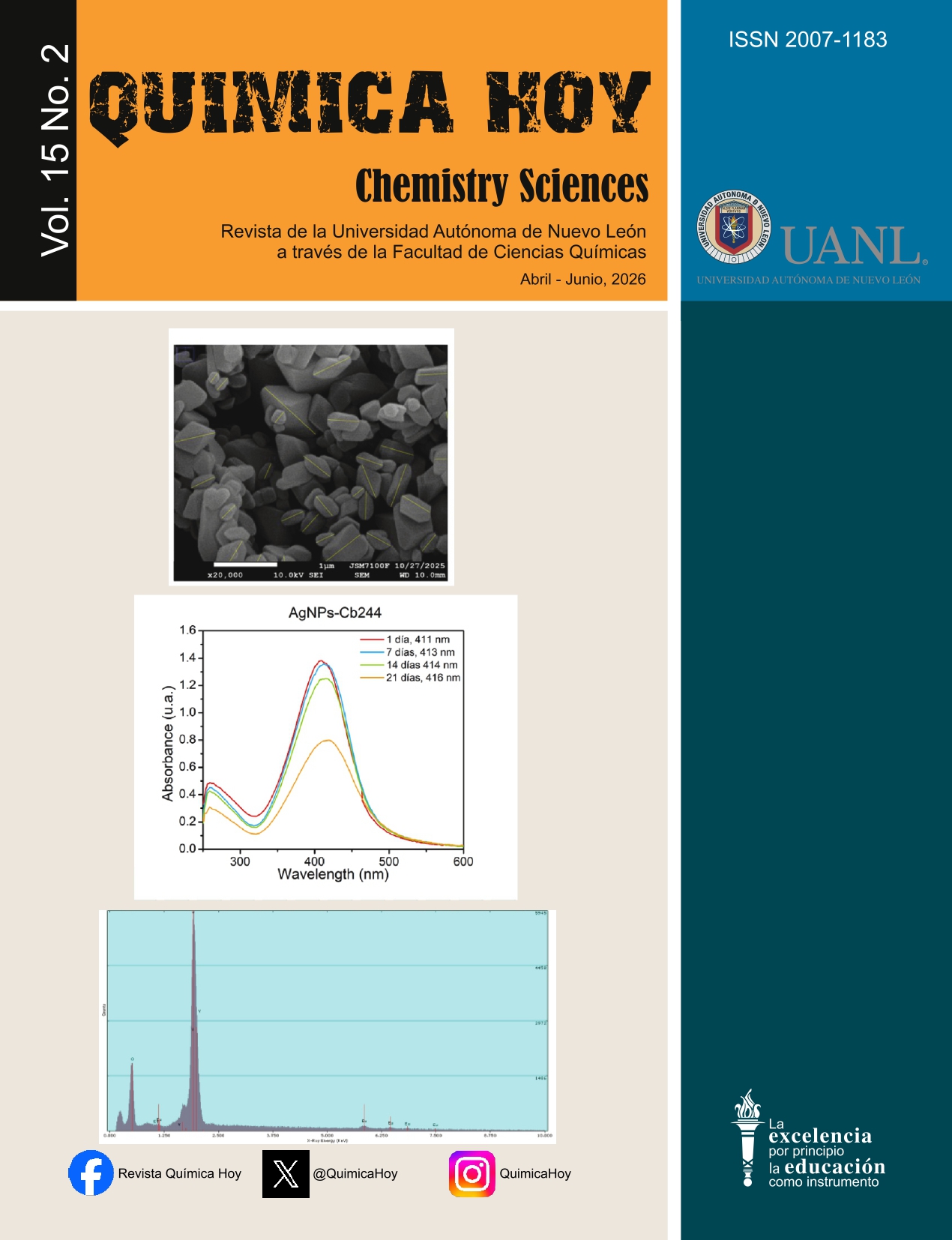
En este estudio se sintetizó el armazón metal-orgánico MIL-53(Al) mediante una ruta hidrotermal verde libre de N,N-dimetilformamida (DMF), utilizando agua como medio de síntesis. El material fue caracterizado mediante DRX, FTIR, SEM, EDS y fisisorción de nitrógeno, confirmando la formación de una estructura cristalina microporosa con un área superficial BET de 1239 m² g⁻¹. La capacidad adsorptiva del MIL-53(Al) se evaluó para la remoción de paracetamol en agua mediante estudios de equilibrio de adsorción. Los datos experimentales se ajustaron a los modelos de Langmuir, Sips y Freundlich obteniéndose el mejor ajuste con el modelo de Sips (R² = 0.98), con una capacidad máxima de adsorción de 42.63 mg g⁻¹. La evaluación mediante DOZN™ evidenció ventajas ambientales asociadas con la eliminación de solventes tóxicos, aunque el alto consumo energético continúa siendo la principal limitación del proceso. Los resultados demuestran que el MIL-53(Al) sintetizado mediante una ruta verde presenta potencial para la remoción de contaminantes farmacéuticos en sistemas acuosos.
Downloads
References
- [1]. T. S. Abd Manan, A. Malakahmad, and S. Sivapalan, “Toxicological studies of Perak River water using biological assay,” Eng. Challenges Sustain. Futur. - Proc. 3rd Int. Conf. Civil, offshore Environ. Eng. ICCOEE 2016, pp. 299–304, 2016, doi: 10.1201/b21942-59. DOI: https://doi.org/10.1201/b21942-59
- [2]. Q. A. Ali and O. A. Ghareeb, “Wastewater Management and Its Role in Achieving the Various Goals of Sustainable Development: A Review,” Emerg. Issues Environ. Geogr. Earth Sci. Vol. 7, no. February, pp. 135–149, 2024, doi: 10.9734/bpi/eieges/v7/11457f. DOI: https://doi.org/10.9734/bpi/eieges/v7/11457F
- [3]. T. Deblonde, C. Cossu-Leguille, and P. Hartemann, “Emerging pollutants in wastewater: A review of the literature,” Int. J. Hyg. Environ. Health, vol. 214, no. 6, pp. 442–448, 2011, doi: 10.1016/j.ijheh.2011.08.002. DOI: https://doi.org/10.1016/j.ijheh.2011.08.002
- [4]. H. B. Quesada, A. T. A. Baptista, L. F. Cusioli, D. Seibert, C. de Oliveira Bezerra, and R. Bergamasco, “Surface water pollution by pharmaceuticals and an alternative of removal by low-cost adsorbents: A review,” Chemosphere, vol. 222, pp. 766–780, 2019, doi: 10.1016/j.chemosphere.2019.02.009. DOI: https://doi.org/10.1016/j.chemosphere.2019.02.009
- [5]. M. Lei et al., “Overview of Emerging Contaminants and Associated Human Health Effects,” Biomed Res. Int., vol. 2015, no. 1, p. 404796, Jan. 2015, doi: 10.1155/2015/404796. DOI: https://doi.org/10.1155/2015/404796
- [6]. A. Food and Drug, “Drug Safety and Risk Management Advisory Committee Meeting.,” 2021. [Online]. Available: http://www.fda.gov/ohrms/dockets/ac/06/briefing/2006-4202_00_TOC.htm.
- [7]. I. Ramos dos Santos et al., “Uso indiscriminado de antiinflamatorios no esteroidales y sus relaciones con enfermedades gastrointestinales,” Cienc. Lat. Rev. Científica Multidiscip., vol. 6, no. 6, pp. 1789–1802, 2022, doi: 10.37811/cl_rcm.v6i6.3637. DOI: https://doi.org/10.37811/cl_rcm.v6i6.3637
- [8]. L. E. Lesser et al., “Survey of 218 organic contaminants in groundwater derived from the world’s largest untreated wastewater irrigation system: Mezquital Valley, Mexico,” Chemosphere, vol. 198, pp. 510–521, 2018, doi: 10.1016/j.chemosphere.2018.01.154. DOI: https://doi.org/10.1016/j.chemosphere.2018.01.154
- [9]. R. Hernández-Tenorio, J. L. Guzmán-Mar, L. Hinojosa-Reyes, N. Ramos-Delgado, and A. Hernández-Ramírez, “Determination of pharmaceuticals discharged in wastewater from a public hospital using lc-ms/ms technique,” J. Mex. Chem. Soc., vol. 65, no. 1, pp. 94–108, 2021, doi: 10.29356/jmcs.v65i1.1439. DOI: https://doi.org/10.29356/jmcs.v65i1.1439
- [10]. J. Li, Q. Ye, and J. Gan, “Degradation and transformation products of acetaminophen in soil,” Water Res., vol. 49, pp. 44–52, 2014, doi: 10.1016/j.watres.2013.11.008.
- [11]. A. V. Hallare, H. R. Köhler, and R. Triebskorn, “Developmental toxicity and stress protein responses in zebrafish embryos after exposure to diclofenac and its solvent, DMSO,” Chemosphere, vol. 56, no. 7, pp. 659–666, Aug. 2004, doi: 10.1016/j.chemosphere.2004.04.007. DOI: https://doi.org/10.1016/j.chemosphere.2004.04.007
- [12]. J. Lee, K. Ji, Y. Lim Kho, P. Kim, and K. Choi, “Chronic exposure to diclofenac on two freshwater cladocerans and Japanese medaka,” Ecotoxicol. Environ. Saf., vol. 74, no. 5, pp. 1216–1225, Jul. 2011, doi: 10.1016/j.ecoenv.2011.03.014. DOI: https://doi.org/10.1016/j.ecoenv.2011.03.014
- [13]. E. J. van den Brandhof and M. Montforts, “Fish embryo toxicity of carbamazepine, diclofenac and metoprolol,” Ecotoxicol. Environ. Saf., vol. 73, no. 8, pp. 1862–1866, Nov. 2010, doi: 10.1016/j.ecoenv.2010.08.031. DOI: https://doi.org/10.1016/j.ecoenv.2010.08.031
- [14]. K. Ji et al., “Effects of non-steroidal anti-inflammatory drugs on hormones and genes of the hypothalamic-pituitary-gonad axis, and reproduction of zebrafish,” J. Hazard. Mater., vol. 254–255, no. 1, pp. 242–251, Jun. 2013, doi: 10.1016/j.jhazmat.2013.03.036. DOI: https://doi.org/10.1016/j.jhazmat.2013.03.036
- [15]. J. Li, Q. Ye, and J. Gan, “Degradation and transformation products of acetaminophen in soil,” Water Res., vol. 49, pp. 44–52, Feb. 2014, doi: 10.1016/j.watres.2013.11.008. DOI: https://doi.org/10.1016/j.watres.2013.11.008
- [16]. H. N. Phong Vo et al., “Acetaminophen micropollutant: Historical and current occurrences, toxicity, removal strategies and transformation pathways in different environments,” Chemosphere, vol. 236, p. 124391, 2019, doi: 10.1016/j.chemosphere.2019.124391. DOI: https://doi.org/10.1016/j.chemosphere.2019.124391
- [17]. P. Pourhakkak, A. Taghizadeh, M. Taghizadeh, M. Ghaedi, and S. Haghdoust, “Fundamentals of adsorption technology,” Interface Sci. Technol., vol. 33, pp. 1–70, Jan. 2021, doi: 10.1016/B978-0-12-818805-7.00001-1. DOI: https://doi.org/10.1016/B978-0-12-818805-7.00001-1
- [18]. I. Anil, S. T. Gunday, A. Bozkurt, and O. Alagha, “Design of Crosslinked Hydrogels Comprising Poly(Vinylphosphonic Acid) and Bis[2-(Methacryloyloxy)Ethyl] Phosphate as an Efficient Adsorbent for Wastewater Dye Removal,” Nanomaterials, vol. 10, no. 1, Jan. 2020, doi: 10.3390/NANO10010131. DOI: https://doi.org/10.3390/nano10010131
- [19]. M. B. Ahmed, J. L. Zhou, H. H. Ngo, and W. Guo, “Adsorptive removal of antibiotics from water and wastewater: Progress and challenges,” Sci. Total Environ., vol. 532, pp. 112–126, 2015, doi: 10.1016/j.scitotenv.2015.05.130. DOI: https://doi.org/10.1016/j.scitotenv.2015.05.130
- [20]. C. WANG, “METAL-ORGANIC MATERIALS FOR HARMFUL ANIONIC SPECIES REMOVAL FROM AQUEOUS,” BMC Public Health, vol. 5, no. 1, pp. 1–8, 2017, [Online]. Available: https://ejournal.poltektegal.ac.id/index.php/siklus/article/view/298%0Ahttp://repositorio.unan.edu.ni/2986/1/5624.pdf%0Ahttp://dx.doi.org/10.1016/j.jana.2015.10.005%0Ahttp://www.biomedcentral.com/1471-2458/12/58%0Ahttp://ovidsp.ovid.com/ovidweb.cgi?T=JS&P
- [21]. R. Rashid, I. Shafiq, P. Akhter, M. J. Iqbal, and M. Hussain, “A state-of-the-art review on wastewater treatment techniques: the effectiveness of adsorption method,” Environ. Sci. Pollut. Res. 2021 288, vol. 28, no. 8, pp. 9050–9066, Jan. 2021, doi: 10.1007/S11356-021-12395-X. DOI: https://doi.org/10.1007/s11356-021-12395-x
- [22]. F. zohra Zeggai, Z. Ait-Touchente, K. Bachari, and A. Elaissari, “Investigation of Metal-Organic Frameworks (MOFs): Synthesis, Properties, and Applications - An In-Depth Review,” Chem. Phys. Impact, vol. 10, no. March, p. 100864, 2025, doi: 10.1016/j.chphi.2025.100864. DOI: https://doi.org/10.1016/j.chphi.2025.100864
- [23]. A. Karami, R. Sabouni, and M. Ghommem, “Experimental investigation of competitive co-adsorption of naproxen and diclofenac from water by an aluminum-based metal-Karami, A., Sabouni, R., & Ghommem, M. (2020). Experimental investigation of competitive co-adsorption of naproxen and diclofenac from,” J. Mol. Liq., vol. 305, p. 112808, 2020, doi: 10.1016/j.molliq.2020.112808.
- [24]. L. Li et al., “The preparation of novel adsorbent materials with efficient adsorption performance for both chromium and methylene blue,” Colloids Surfaces B Biointerfaces, vol. 141, pp. 253–259, May 2016, doi: 10.1016/J.COLSURFB.2015.06.023. DOI: https://doi.org/10.1016/j.colsurfb.2015.06.023
- [25]. M. Zeraati, A. Rahdar, D. I. Medina, and G. Sargazi, “Synthesis of Al-Based Metal-Organic Framework in Water With Caffeic Acid Ligand and NaOH as Linker Sources With Highly Efficient Anticancer Treatment,” Front. Chem., vol. 9, no. November 2021, pp. 1–9, 2021, doi: 10.3389/fchem.2021.784461. DOI: https://doi.org/10.3389/fchem.2021.784461
- [26]. P. Sharma and E. Ponnusamy, “DOZNTM 2.0: A quantitative green chemistry evaluator for a sustainable future,” J. Organomet. Chem., vol. 970–971, p. 122367, 2022, doi: 10.1016/j.jorganchem.2022.122367. DOI: https://doi.org/10.1016/j.jorganchem.2022.122367
- [27]. B. Choi, S. Jeong, and Y. Park, “Exploring the Potential of High Value-Added Recycling of Wool Wastes with the Aid of Sustainable Process Design by DOZNTM,” J. Nat. Fibers, vol. 22, no. 1, 2025, doi: 10.1080/15440478.2025.2508285. DOI: https://doi.org/10.1080/15440478.2025.2508285
- [28]. F. G. Quintero-Álvarez, C. K. Rojas-Mayorga, D. I. Mendoza-Castillo, I. A. Aguayo-Villarreal, and A. Bonilla-Petriciolet, “Physicochemical Modeling of the Adsorption of Pharmaceuticals on MIL-100-Fe and MIL-101-Fe MOFs,” Adsorpt. Sci. Technol., vol. 2022, 2022, doi: 10.1155/2022/4482263. DOI: https://doi.org/10.1155/2022/4482263
- [29]. C. A. Igwegbe et al., “Environmental protection by the adsorptive elimination of acetaminophen from water: A comprehensive review,” J. Ind. Eng. Chem., vol. 104, pp. 117–135, 2021, doi: 10.1016/j.jiec.2021.08.015. DOI: https://doi.org/10.1016/j.jiec.2021.08.015
- [30]. P. E. Stackelberg, J. Gibs, E. T. Furlong, M. T. Meyer, S. D. Zaugg, and R. L. Lippincott, “Efficiency of conventional drinking-water-treatment processes in removal of pharmaceuticals and other organic compounds,” Sci. Total Environ., vol. 377, no. 2–3, pp. 255–272, May 2007, doi: 10.1016/J.SCITOTENV.2007.01.095. DOI: https://doi.org/10.1016/j.scitotenv.2007.01.095
- [31]. G. A. Cobian-Solorio, I. A. Aguayo-Villarreal, C. K. Rojas-Mayorga, R. Muñiz-Valencia, M. J. Emparan-Legaspi, and N. E. Davila Guzman, “Non-steroidal anti-inflammatory drugs adsorption from aqueous solution by MOFs MIL-100(Fe), ZIF-8 and UiO-66: Synthesis, characterization, and comparative study,” J. Mol. Struct., vol. 1321, no. May 2024, 2025, doi: 10.1016/j.molstruc.2024.139698. DOI: https://doi.org/10.1016/j.molstruc.2024.139698
- [32]. T. Loiseau et al., “A rationale for the large breathing of the porous aluminum terephthalate (MIL-53) upon hydration,” Chemistry, vol. 10, no. 6, pp. 1373–1382, Apr. 2004, doi: 10.1002/CHEM.200305413. DOI: https://doi.org/10.1002/chem.200305413
- [33]. M. Sánchez-sánchez, N. Getachew, M. Díaz-garcía, Y. Chebude, and I. Díaz, “room temperature : salts as linker sources †,” pp. 1500–1509, 2015, doi: 10.1039/c4gc01861c. DOI: https://doi.org/10.1039/C4GC01861C
- [34]. P. Rallapalli, D. Patil, K. P. Prasanth, R. S. Somani, R. V. Jasra, and H. C. Bajaj, “An alternative activation method for the enhancement of methane storage capacity of nanoporous aluminium terephthalate, MIL-53(Al),” J. Porous Mater., vol. 17, no. 5, pp. 523–528, 2010, doi: 10.1007/s10934-009-9320-5. DOI: https://doi.org/10.1007/s10934-009-9320-5
- [35]. N. Ahadi, S. Askari, A. Fouladitajar, and I. Akbari, “Facile synthesis of hierarchically structured MIL-53(Al) with superior properties using an environmentally-friendly ultrasonic method for separating lead ions from aqueous solutions,” Sci. Rep., vol. 12, no. 1, pp. 1–17, 2022, doi: 10.1038/s41598-022-06518-8. DOI: https://doi.org/10.1038/s41598-022-06518-8
- [36]. A. Taheri, E. G. Babakhani, and J. Towfighi, “Study of synthesis parameters of MIL-53(Al) using experimental design methodology for CO2/CH4 separation,” Adsorpt. Sci. Technol., vol. 36, no. 1–2, pp. 247–269, 2018, doi: 10.1177/0263617416688690. DOI: https://doi.org/10.1177/0263617416688690
- [37]. J. Rouquerol, P. Llewellyn, and F. Rouquerol, “Is the BET equation applicable to microporous adsorbents?,” Stud. Surf. Sci. Catal., vol. 160, no. December 2007, pp. 49–56, 2007, doi: 10.1016/s0167-2991(07)80008-5. DOI: https://doi.org/10.1016/S0167-2991(07)80008-5
- [38]. S. Y. Kim, J. H. Kang, S. I. Kim, and Y. S. Bae, “Extraordinarily large and stable methane delivery of MIL-53(Al) under LNG-ANG conditions,” Chem. Eng. J., vol. 365, pp. 242–248, 2019, doi: 10.1016/j.cej.2019.01.182. DOI: https://doi.org/10.1016/j.cej.2019.01.182
- [39]. E. Rahmani and M. Rahmani, “Al-Based MIL-53 Metal Organic Framework (MOF) as the New Catalyst for Friedel-Crafts Alkylation of Benzene,” Ind. Eng. Chem. Res., vol. 57, no. 1, pp. 169–178, 2018, doi: 10.1021/acs.iecr.7b04206. DOI: https://doi.org/10.1021/acs.iecr.7b04206
- [40]. A. Karami, R. Sabouni, and M. Ghommem, “Experimental investigation of competitive co-adsorption of naproxen and diclofenac from water by an aluminum-based metal- organic framework,” J. Mol. Liq., vol. 305, p. 112808, 2020, doi: 10.1016/j.molliq.2020.112808. DOI: https://doi.org/10.1016/j.molliq.2020.112808
- [41]. J. L. Woodliffe, R. S. Ferrari, I. Ahmed, and A. Laybourn, “Evaluating the purification and activation of metal-organic frameworks from a technical and circular economy perspective,” Coord. Chem. Rev., vol. 428, p. 213578, 2021, doi: 10.1016/j.ccr.2020.213578. DOI: https://doi.org/10.1016/j.ccr.2020.213578
- [42]. J. Imanipoor, M. Mohammadi, M. Dinari, and M. R. Ehsani, “Adsorption and Desorption of Amoxicillin Antibiotic from Water Matrices Using an Effective and Recyclable MIL-53(Al) Metal-Organic Framework Adsorbent,” J. Chem. Eng. Data, vol. 66, no. 1, pp. 389–403, 2021, doi: 10.1021/acs.jced.0c00736. DOI: https://doi.org/10.1021/acs.jced.0c00736
- [43]. C. Li, Z. Xiong, J. Zhang, and C. Wu, “The Strengthening Role of the Amino Group in Metal-Organic Framework MIL-53 (Al) for Methylene Blue and Malachite Green Dye Adsorption,” J. Chem. Eng. Data, vol. 60, no. 11, pp. 3414–3422, Nov. 2015, doi: 10.1021/ACS.JCED.5B00692/SUPPL_FILE/JE5B00692_SI_001.PDF. DOI: https://doi.org/10.1021/acs.jced.5b00692
- [44]. Z. Jia, M. Jiang, and G. Wu, “Amino-MIL-53(Al) sandwich-structure membranes for adsorption of p-nitrophenol from aqueous solutions,” Chem. Eng. J., vol. 307, pp. 283–290, 2017, doi: 10.1016/j.cej.2016.08.090. DOI: https://doi.org/10.1016/j.cej.2016.08.090
- [45]. M. Al Sharabati and R. Sabouni, “Selective removal of dual dyes from aqueous solutions using a metal organic framework (MIL-53(Al)),” Polyhedron, vol. 190, p. 114762, 2020, doi: 10.1016/j.poly.2020.114762. DOI: https://doi.org/10.1016/j.poly.2020.114762
- [46]. A. Skwarczynska-Wojsa and A. Puszkarewicz, “Removal of Acetaminophen from Aqueous Solutions in an Adsorption Process,” Materials (Basel)., vol. 17, no. 2, p. 431, Jan. 2024, doi: 10.3390/ma17020431. DOI: https://doi.org/10.3390/ma17020431
- [47]. H. Nourmoradi, K. F. Moghadam, A. Jafari, and B. Kamarehie, “Removal of acetaminophen and ibuprofen from aqueous solutions by activated carbon derived from Quercus Brantii (Oak) acorn as a low-cost biosorbent,” J. Environ. Chem. Eng., vol. 6, no. 6, pp. 6807–6815, 2018, doi: 10.1016/j.jece.2018.10.047. DOI: https://doi.org/10.1016/j.jece.2018.10.047
- [48]. H. B. Quesada et al., “Acetaminophen adsorption using a low-cost adsorbent prepared from modified residues of Moringa oleifera Lam. seed husks,” J. Chem. Technol. Biotechnol., vol. 94, no. 10, pp. 3147–3157, 2019, doi: 10.1002/jctb.6121. DOI: https://doi.org/10.1002/jctb.6121
- [49]. M. Sajid, S. Bari, M. Saif Ur Rehman, M. Ashfaq, Y. Guoliang, and G. Mustafa, “Adsorption characteristics of paracetamol removal onto activated carbon prepared from Cannabis sativum Hemp,” Alexandria Eng. J., vol. 61, no. 9, pp. 7203–7212, Sep. 2022, doi: 10.1016/J.AEJ.2021.12.060. DOI: https://doi.org/10.1016/j.aej.2021.12.060
- [50]. P. Baeza et al., “Effect of the Incorporation of Ni in the Adsorption Capacity of Paracetamol (N-Acetyl-P-Aminophenol) on MIL-101(Cr),” Water. Air. Soil Pollut., vol. 231, no. 5, 2020, doi: 10.1007/s11270-020-04584-0. DOI: https://doi.org/10.1007/s11270-020-04584-0
Downloads
Published
How to Cite
Issue
Section
License
Copyright (c) 2026 Marybel Anahi Castillo Ferat, Jacob Josafat Salazar Rabago, Refugio Bernardo Garcia Reyes, Jesús Botello González, Nancy Elizabeth Davila Guzman

This work is licensed under a Creative Commons Attribution 4.0 International License.