Síntesis verde de nanopartículas de plata mediada por Cordia boissieri: caracterización fisicoquímica y evaluación preliminar de biocompatibilidad
DOI:
https://doi.org/10.29105/qh15.02-532Keywords:
Síntesis ecológica, Nanopartículas de plata, Cordia boissieriAbstract
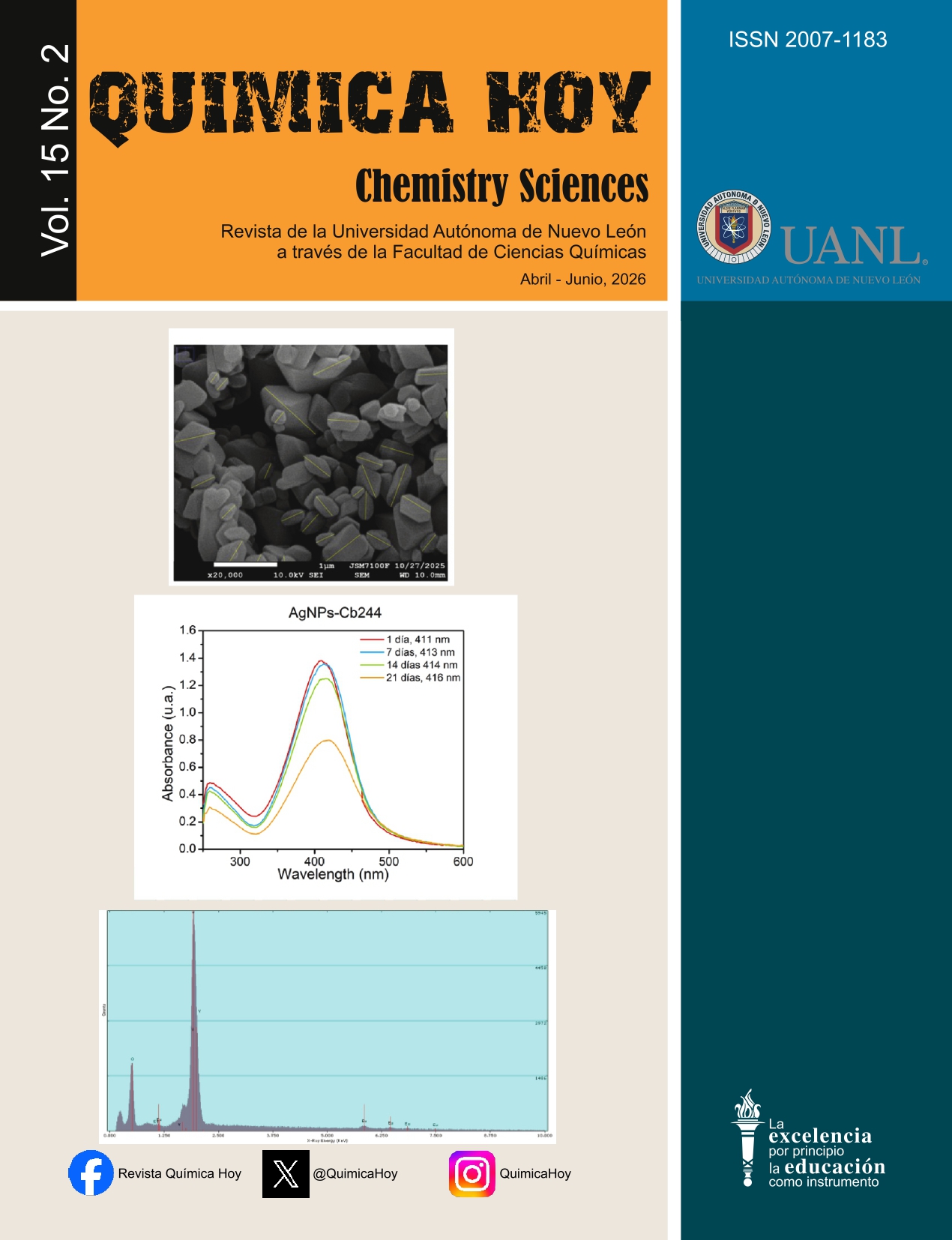
En este estudio, se describe una síntesis ecológica de nanopartículas de plata (AgNps) empleando los extractos metanólicos obtenidos de Cordia boissieri, que actúan como agentes estabilizadores y reductores naturales. Se prepararon dos formulaciones (AgNps-Cb244 y AgNps-Cb525) para evaluar su efecto en las propiedades físico-químicas y biocompatibilidad celular. La formación de nanopartículas se confirmó mediante espectro UV-Vis, donde se observaron bandas características del plasmón de resonancia superficial a aproximadamente 411 y 408 nm, respectivamente, las cuales se mantuvieron estables durante 21 días. El análisis de dispersión dinámica de luz (DLS) reveló tamaños de partícula promedio de alrededor de 50 nm, con baja polidispersidad y valores negativos de potencial zeta, lo que indica una buena estabilidad coloidal. Los ensayos de viabilidad celular realizados en células endoteliales humanas (HUVEC) a las 24 horas mediante el método MTS demostraron una respuesta dependiente de la concentración, con una citotoxicidad reducida en comparación con el precursor metálico (AgNO₃). En resumen, estos datos resaltan la capacidad, del extracto de C. boissieri como una alternativa para la síntesis de nanopartículas de plata con aplicaciones prometedoras en el área biomédica.
Downloads
References
- [1]. García-Ponce, R., Hernández-Escareño, J. J., Cruz-Valdez, J. C., Galindo-Rodríguez, S. A., Heya, M. S., & Villarreal-Villarreal, J. P. (2023). Ixodicidal effect of extracts from Cordia boissieri, Artemisia ludoviciana and Litchi chinensis on Rhipicephalus (Boophilus) microplus (Acari: Ixodidae). Brazilian Journal of Biology, 84, e264425. DOI: https://doi.org/10.1590/1519-6984.264425
- [2]. Viveros-Valdez, E., Jaramillo-Mora, C., Oranday-Cárdenas, A., Morán-Martínez, J., & Carranza-Rosales, P. (2016). Antioxidant, cytotoxic and alpha-glucosidase inhibition activities from the Mexican berry Anacahuita (Cordia boissieri). Archivos Latinoamericanos de Nutrición, 66, 211–218.
- [3]. Dresler, S., Szymczak, G., & Wójcik, M. (2017). Comparison of some secondary metabolite content in the seventeen species of the Boraginaceae family. Pharmaceutical Biology, 55(1), 691–695. DOI: https://doi.org/10.1080/13880209.2016.1265986
- [4]. Salazar-Aranda, R., Pérez-López, L. A., López-Arroyo, J., Alanís Garza, B. A., & Waksman de Torres, N. W. (2011). Antimicrobial and antioxidant activities of plants from northeast of Mexico. Evidence-Based Complementary and Alternative Medicine, 2011, 536139. DOI: https://doi.org/10.1093/ecam/nep127
- [5]. Iravani, S. (2011). Green synthesis of metal nanoparticles using plants. Green Chemistry, 13, 2638–2650. DOI: https://doi.org/10.1039/c1gc15386b
- [6]. Koduru, J. R., Kailasa, S. K., Bhamore, J. R., Kim, K. H., Dutta, T., & Vellingiri, K. (2018). Green synthesis of metal nanoparticles using plant extracts and their applications: A review. Advances in Colloid and Interface Science, 256, 326–339. DOI: https://doi.org/10.1016/j.cis.2018.03.001
- [7]. Prabhu, S., & Poulose, E. K. (2012). Silver nanoparticles: Mechanism of antimicrobial action, synthesis, medical applications, and toxicity effects. International Nano Letters, 2, 1–10. DOI: https://doi.org/10.1186/2228-5326-2-32
- [8]. Thakkar, K. N., Mhatre, S. S., & Parikh, R. Y. (2010). Biological synthesis of metallic nanoparticles. Nanomedicine: Nanotechnology, Biology and Medicine, 6(2), 257–262. DOI: https://doi.org/10.1016/j.nano.2009.07.002
- [9]. Vijayaraghavan, K., Karthik, K., & Ashokkumar, S. (2014). Plant-mediated biosynthesis of metallic nanoparticles: A review of literature, factors affecting synthesis, characterization techniques and applications. Journal of Environmental Chemical Engineering, 2(1), 494–503.
- [10]. Alireza, E., Yahya, B., Younes, G., & Aydin, B. (2017). Green synthesis of silver nanoparticles using Eucalyptus camaldulensis leaf extract and evaluation of their antimicrobial effect. Chemical Industry & Chemical Engineering Quarterly, 23(1), 31–37.
- [11]. Dubey, S. P., Lahtinen, M., Särkkä, H., & Sillanpää, M. (2010). Bioprospective of Terminalia chebula leaf extract in synthesis of silver nanoparticles. Colloids and Surfaces B: Biointerfaces, 80, 26–33.
- [12]. Gallo, A., Bianco, C., Tosco, T., et al. (2019). A green approach for the synthesis of silver nanoparticles using Cistus monspeliensis extract. Journal of Cleaner Production, 211, 1367–1374. DOI: https://doi.org/10.1016/j.jclepro.2018.10.298
- [13]. Khan, S. U., Anjum, S. I., Ansari, M. J., et al. (2019). Synthesis and characterization of silver nanoparticles from Olea europaea leaf extract. Saudi Journal of Biological Sciences, 26(7), 1815–1834. DOI: https://doi.org/10.1016/j.sjbs.2018.02.010
- [14]. Naikoo, G. A., Mustaqeem, M., Hassan, I. U., et al. (2021). Biosynthesis of silver nanoparticles using Trifolium pratense extract. Journal of Saudi Chemical Society, 25, 101304. DOI: https://doi.org/10.1016/j.jscs.2021.101304
- [15]. Philip, D. (2011). Mangifera indica leaf-assisted biosynthesis of well-dispersed silver nanoparticles. Spectrochimica Acta Part A: Molecular and Biomolecular Spectroscopy, 78(1), 327–331. DOI: https://doi.org/10.1016/j.saa.2010.10.015
- [16]. Rajeshkumar, S., & Malarkodi, C. (2014). Green synthesis of silver nanoparticles using Ocimum sanctum and their antimicrobial activity. Materials Letters, 137, 246–249.
- [17]. Roy, A., Das, A., Jha, M., et al. (2013). Green synthesis of silver nanoparticles using Azadirachta indica and their antibacterial efficacy. International Journal of Nanomedicine, 8, 681–690.
- [18]. Sathishkumar, M., Sneha, K., Won, S. W., et al. (2009). Cinnamon zeylanicum bark extract and powder mediated green synthesis of nano-crystalline silver particles and its bactericidal activity. Colloids and Surfaces B: Biointerfaces, 73(2), 332–338. DOI: https://doi.org/10.1016/j.colsurfb.2009.06.005
- [19]. Song, J. Y., & Kim, B. S. (2009). Rapid biological synthesis of silver nanoparticles using Plantago asiatica extract. Bioprocess and Biosystems Engineering, 32(1), 79–84. DOI: https://doi.org/10.1007/s00449-008-0224-6
- [20]. Banala, R. R., Nagati, V. B., & Karnati, P. R. (2015). Green synthesis and characterization of Carica papaya leaf extract coated silver nanoparticles through X-ray diffraction, electron microscopy and evaluation of bactericidal properties. Saudi Journal of Biological Sciences, 22(5), 637–644. DOI: https://doi.org/10.1016/j.sjbs.2015.01.007
- [21]. Hasson, B. A., Ismail, A., Maeh, R. K., & Al-Azawi, K. F. (2021). Preparation and characterization of silver nanoparticle by Cordia myxa extract and their study anticancer, antioxidant, antibacterial activity. Indian Journal of Forensic Medicine and Toxicology, 15(3), 5458–5465. https://doi.org/10.37506/ijfmt.v15i3.16625 DOI: https://doi.org/10.37506/ijfmt.v15i3.16625
- [22]. Kumari, M., Thapa, N., Gupta, N., et al. (2016). Antibacterial and photocatalytic degradation efficacy of silver nanoparticles biosynthesized using Cordia dichotoma leaf extract. Advances in Natural Sciences: Nanoscience and Nanotechnology, 7(4), 045009.
- [23]. Ramalingam, A., & Udayaprakash, N. K. (2019). Optimization of florisynthesis of silver nanoparticles using Cordia sebastena Linn. IOP Conference Series: Materials Science and Engineering, 574, 012017. DOI: https://doi.org/10.1088/1757-899X/574/1/012017
- [24]. Panacek, A., Kvitek, L., Prucek, R., Kolar, M., Vecerova, R., Pizurova, N., Koci, V., et al. (2006). Silver colloid nanoparticles: Synthesis, characterization, and their antibacterial activity. Journal of Physical Chemistry B, 110(33), 16248–16253. DOI: https://doi.org/10.1021/jp063826h
- [25]. Rai, M., Yadav, A., & Gade, A. (2009). Silver nanoparticles as a new generation of antimicrobials. Biotechnology Advances, 27(1), 76–83. DOI: https://doi.org/10.1016/j.biotechadv.2008.09.002
- [26]. Sharma, V. K., Yngard, R. A., & Lin, Y. (2009). Silver nanoparticles: Green synthesis and their antimicrobial activities. Advances in Colloid and Interface Science, 145, 83–96. DOI: https://doi.org/10.1016/j.cis.2008.09.002
- [27]. Shrivastava, S., Bera, T., Roy, A., et al. (2007). Characterization of enhanced antibacterial effects of novel silver nanoparticles. Nanotechnology, 18(22), 225103. DOI: https://doi.org/10.1088/0957-4484/18/22/225103
- [28]. Wei, L., Lu, J., Xu, H., et al. (2009). Silver nanoparticles: Synthesis, characterization and antibacterial activity against Escherichia coli. Journal of Nanoscience and Nanotechnology, 9(1), 5735–5741.
- [29]. Lara, H. H., Ayala-Nuñez, N. V., Ixtepan-Turrent, L., & Rodriguez-Padilla, C. (2010). Bactericidal effect of silver nanoparticles against multidrug-resistant bacteria. Journal of Nanobiotechnology, 8, 1–10.
- [30]. Palai, P. K., Mondal, A., Chakraborti, C. K., et al. (2019). Antioxidant and antibacterial activities of silver nanoparticles synthesized using Murraya koenigii. SN Applied Sciences, 1, 1–18.
- [31]. Ramachandran, R., Krishnamurthy, S., Arumugam, M. S., et al. (2019). Eco-friendly synthesis of silver nanoparticles using Ficus benghalensis and their biomedical applications. Journal of Photochemistry and Photobiology B: Biology, 192, 1–8.
- [32]. Ravi, S., Gopikrishnan, R. R. R., Thiyagarajan, S., & Dhanasekaran, R. (2021). Green synthesis of silver nanoparticles using Sphaeranthus indicus and their antimicrobial and wound healing properties. Journal of Drug Delivery Science and Technology, 61, 102169.
- [33]. Thomas, R., Jenifer, D., Anbazhagan, D., et al. (2021). Green synthesis of silver nanoparticles using Sida cordifolia and its applications in wound healing and antibacterial activity. Materials Science and Engineering: C, 123, 111956.
- [34]. Wypij, M., Czarnecka, D., Krajewski, R., et al. (2021). Green synthesized silver nanoparticles with antimicrobial and anticancer potential. Materials, 14(5), 1121.
- [35]. Samberg, M. E., Oldenburg, S. J., & Monteiro-Riviere, N. A. (2010). Evaluation of silver nanoparticle toxicity in skin in vitro and in vivo. Environmental Health Perspectives, 118(3), 407–413. DOI: https://doi.org/10.1289/ehp.0901398
Downloads
Published
How to Cite
Issue
Section
License
Copyright (c) 2026 Jennifer Citlally Leos Rivera, Sleidy Pamela González Cázares, Raúl Rangel López, Sergio Arturo Galindo Rodríguez, Enrique Manuel López Cuellar, Diana Ginette Zárate Triviño

This work is licensed under a Creative Commons Attribution 4.0 International License.